I. Introduction
UAM(urban air mobility) is a future air transportation system that operates in urban areas. The future transportation system is shifting from a ground-based framework to a new paradigm that utilizes three-dimensional space. Recently, Urban Air Mobility (UAM) has been proposed as a next-generation transportation system that utilizes urban airspace. The United States and Europe have already designated UAM as a national strategic initiative and are actively promoting it as a core industry.
In South Korea, research has progressed actively since the announcement of the “K-UAM Roadmap” in 2020. However, commercialization based on service implementation has faced limitations, resulting in the withdrawal of private sector participants and increasingly challenging conditions. The success of UAM development depends not only on technological advancement or infrastructure construction but fundamentally on user acceptance. Therefore, this study aims to diagnose the level of social perception regarding UAM vertiport development.
The purpose of this study is to empirically analyze the level of social perception toward UAM vertiport development in areas surrounding airports and to derive policy implications based on the findings.
Social factors examined include awareness, policy acceptance, living and environmental perception, and intention to use. Technical factors include perceived usefulness, perceived Convenience, safety, and security. Through examining the interactions among these factors that constitute social and technical acceptance, this study seeks to derive an Integrated Acceptance model.
This research defines UAM vertiport development not merely as a technological demonstration project but as a process of building social acceptance and trust. By structuring this process through empirical analysis, the study aims to establish both theoretical and practical foundations for future UAM policy implementation.
II. Research Method
This study proposes an Integrated Acceptance Model. UAM acceptance is analyzed by integrating social acceptance and technological acceptance. The theoretical framework is established based on the hypothesis that both social and technological acceptance converge into integrated acceptance. Given the introduction of UAM, it is necessary to analyze the interaction and influence between these two dimensions.
Social acceptance refers to the degree of approval and support from members of society regarding a particular technology, facility, or policy. It is defined as “the process by which technologies or facilities considered socially acceptable are approved and adopted by members of society.”
Social acceptance is a complex socio-psychological phenomenon that cannot be explained solely by technological superiority or economic feasibility. It plays a critical role in the process of technology introduction and diffusion.
The Technology Acceptance Model (TAM) is a representative theoretical framework explaining how new information technologies or systems are accepted by users and translated into actual usage. First proposed by Davis (1986, 1989), TAM is grounded in the Theory of Reasoned Action (TRA). Davis applied socio-psychological behavioral theory to the information technology context, explaining technology acceptance from the perspective of cognitive judgment and attitude formation.
The Unified Theory of Acceptance and Use of Technology (UTAUT) explains behavioral intention and actual use by categorizing acceptance factors into cognitive, social, and environmental dimensions. It consists of four core constructs: performance expectancy, effort expectancy, social influence, and facilitating conditions.
This study measures social perception regarding the introduction of UAM vertiports in airport-adjacent areas. An extended model based on TAM was designed. Variables were operationalized by referencing TAM, UTAUT, social acceptance theory, and prior acceptance studies.
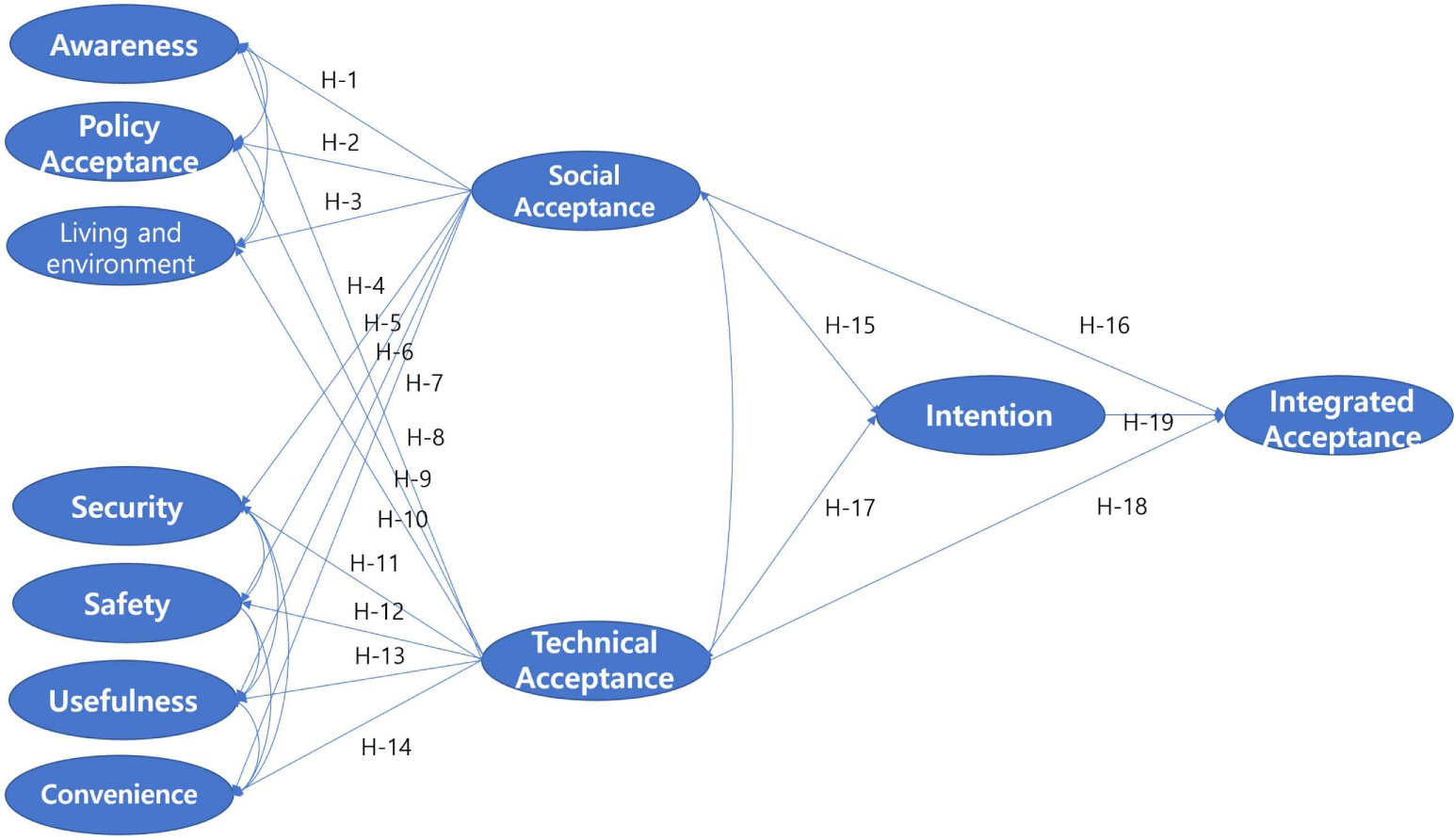
Awareness refers to the extent to which respondents understand the concept, functions, and purpose of UAM and verti-hubs. Perceived usefulness refers to the belief that UAM services enhance mobility efficiency and benefits. Perceived Convenience refers to the degree to which UAM services are considered easy and convenient to use.
Safety refers to the perception that UAM technologies and operational systems sufficiently ensure passenger and ground safety. Security refers to the perception that UAM systems are protected from threats such as hacking, terrorism, and data breaches.
Policy acceptance refers to the level of trust in the fairness, transparency, and governance capacity of government UAM policy implementation. Living and environmental perception refers to evaluative perceptions regarding UAM’s impact on local life and the environment.
Intention to use refers to the respondent’s willingness to use UAM services or recommend them to others. Integrated acceptance refers to the overall acceptance attitude formed by the combination of technological trust and social trust.
To empirically validate this theoretical structure, a covariance-based Structural Equation Modeling (SEM) approach was employed. SEM was selected because the proposed model involves multiple latent constructs and hypothesized direct and indirect relationships that must be estimated simultaneously within a unified analytical framework.
III. Data Collection and Results
A survey was conducted among residents living near airports to examine integrated acceptance of UAM and verti-hub development.
The questionnaire consisted of 35 items measured on a 7-point Likert scale. A total of 800 valid responses were analyzed using SPSS 26.0 for descriptive statistics, reliability analysis, and exploratory factor analysis(EFA), and AMOS 27.0 for confirmatory factor analysis(CFA) and structural equation modeling(SEM). Reliability (Cronbach’s α≥.70) and validity (AVE, CR) were confirmed.
Females accounted for 57.0% of respondents and males 43.0%. The largest age group was individuals in their 60s (27.9%), followed by those in their 50s (23.7%).
Self-employed respondents comprised the largest occupational group. Regarding airport usage frequency, 59.6% used Gimpo Airport once per quarter, while 24.0% used it at least once per month (Table 1).
Descriptive statistics were analyzed for the measurement items of the nine latent variables established in this study. Based on the results of the descriptive statistical analysis, respondents’ perception levels for each latent construct were examined.
The findings indicate that policy acceptance showed a relatively low mean score of 3.787. This suggests the need for more proactive governmental communication and promotion regarding UAM policy initiatives. Living and environmental perception (4.142), intention to use (4.267), safety (4.088), and perceived usefulness (4.386) were all slightly above the midpoint value of 4.0. This implies that respondents exhibit neutral to slightly positive attitudes toward UAM vertiports in terms of improvements to local living conditions and environment, practical usage value, safety, and usefulness.
In contrast, the perception of security was 3.931, slightly below the midpoint, indicating a relatively low level of confidence. This suggests that respondents hold somewhat skeptical views regarding security aspects when using UAM vertiports. Most notably, awareness recorded the lowest mean score among the nine variables at 3.527. This indicates that public awareness and understanding of UAM and vertiports have not yet been sufficiently established.
The overall Cronbach’s alpha of the scale was 0.961, demonstrating an excellent level of internal consistency. At the construct level, security (α=0.960), policy acceptance (α=0.960), integrated acceptance (α=0.959), perceived usefulness (α=0.960), perceived convenience (α=0.960), and living and environmental perception (α=0.959) all showed very high reliability, exceeding 0.90. Safety (α=0.963), intention to use (α=0.959), and awareness (α=0.961) likewise demonstrated excellent internal consistency, indicating a very high degree of response reliability (Table 2, Table 3).
The results of structural equation AMOS analysis are as follows. First, policy acceptance exerted the strongest positive influence on social acceptance, followed by living and environmental perception. Safety and security did not significantly influence social acceptance. Second, perceived usefulness and Convenience significantly influenced intention to use, supporting TAM and UTAUT pathways. Intention to use significantly influenced technological acceptance, and technological acceptance significantly influenced integrated acceptance. Social acceptance directly influenced integrated acceptance as well.
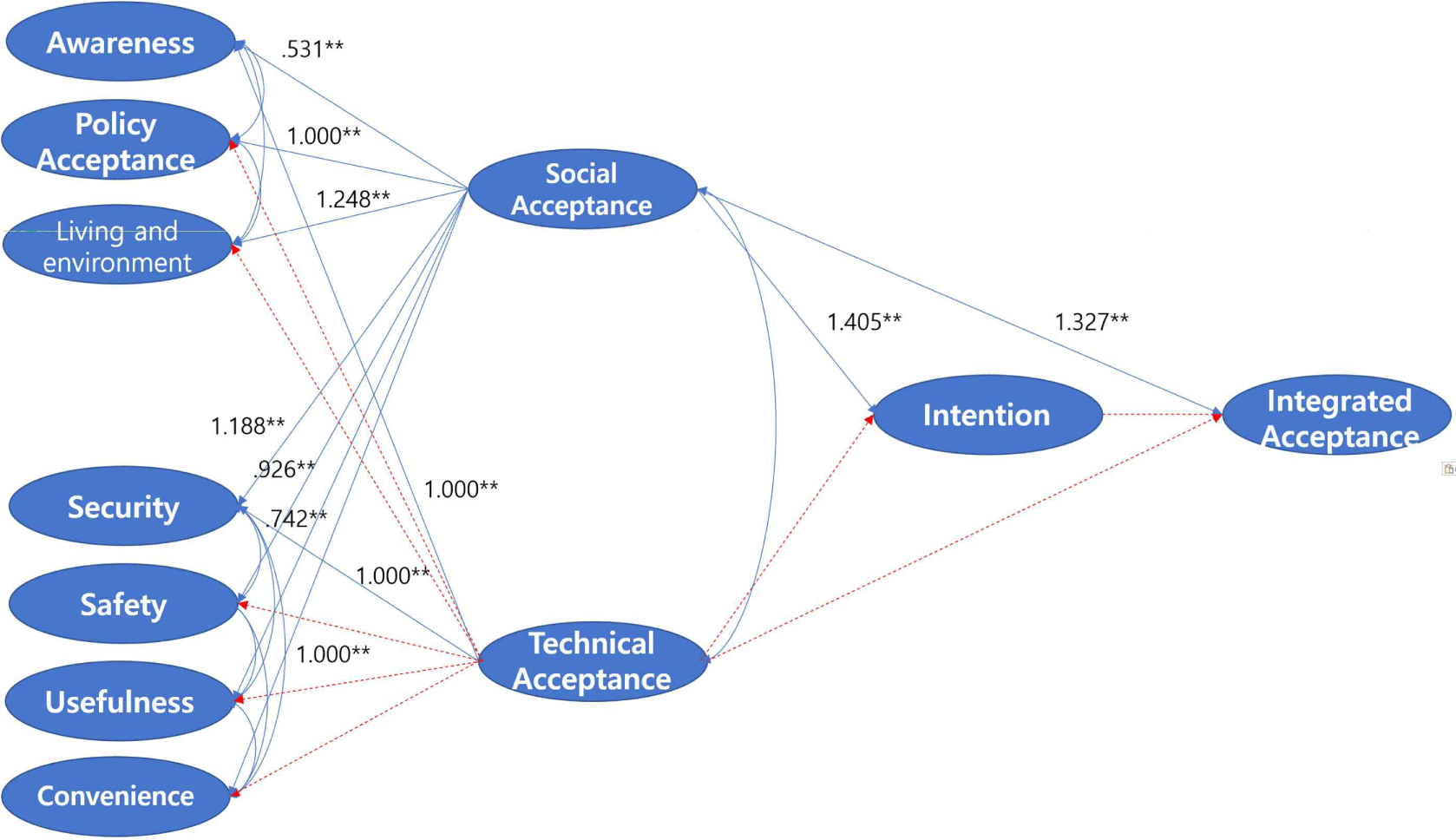
However, technological acceptance did not significantly influence integrated acceptance in the final structural model, suggesting that uncertainty and skepticism regarding UAM technology act as barriers.
These findings indicate that although bothsocial and technological factors contribute to integrated acceptance, social acceptance plays a more dominant role in shaping public attitudes toward UAM vertiports.
The results of the hypothesis testing can be summarized as follows.
First, in the formation pathway of social acceptance, all seven latent factors constituting social acceptance were found to have statistically significant effects at the 99% confidence level. Accordingly, Hypotheses H1 through H7 were all supported.
Second, in the formation of technological acceptance, awareness (β=1.000***) and security (β=1.000***) were found to exert statistically significant positive (+) effects at the 99% confidence level. Therefore, Hypotheses H8 and H11 were supported.
Third, social acceptance was found to have highly significant effects at the 99% confidence level on both intention to use and integrated acceptance. The effect of social acceptance on intention to use was estimated at β=1.405 (p<0.001) and β=1.327 (p<0.001), respectively. In contrast, technological acceptance was found to have no statistically significant effect on either intention to use or integrated acceptance. Accordingly, Hypotheses H15 and H17 were supported.
These findings demonstrate that although the formation of integrated acceptance of UAM vertiports theoretically requires a multi-layered process encompassing both social and technological dimensions, uncertainty and skepticism toward UAM technology—particularly given its lack of commercialization—constitute the most critical barrier preventing technological acceptance from translating into integrated acceptance.
The empirical results suggest that citizens have not yet developed clear confidence in the technological feasibility, safety, and reliability of UAM systems.
IV. Conclusion
Based on empirical data from residents near airports, this study demonstrates that UAM vertiport policy should prioritize social acceptance rather than solely focusing on technological development.
While traditional technology acceptance theory emphasizes the pathway of usefulness and Convenience leading to behavioral intention and technological acceptance, the addition of social acceptance alters this dynamic. The findings suggest that UAM adoption should be approached from a social acceptance perspective rather than relying exclusively on traditional TAM or UTAUT frameworks.
The results indicate that social acceptance encompasses and conditions technological acceptance in public perception. Therefore, UAM policy must prioritize participatory decision-making structures that consider policy trust, environmental impacts, and public interest.
Beyond policy promotion, visible technological validation through pilot projects and demonstrable performance outcomes is essential. Furthermore, prior aviation experience plays a moderating role in acceptance formation, highlighting the importance of technological literacy and experiential understanding.
This study contributes academically by integrating social and technological acceptance within a concrete urban policy context and by establishing the concept of integrated acceptance formed through the combination of social and technological trust.

