
 PDF Download
 PubReader
 Export Citation
 Email the Author
 Share Facebook
 Share Twitter
 Cited by 0 Article
 Metrics (View:1,003)






I. Introduction
With the advancement of aircraft automation and the remarkable development of aviation science and technology, aircraft defects caused by maintenance and technical factors have significantly decreased. In contrast, the proportion of accidents attributed to human factors has shown a relative increase (Table 1).
The 2015 TransAsia Airways Flight 235 crash is regarded as a representative human factorrelated accident, in which the flight crew mistakenly shut down the operative engine instead of the malfunctioning engine during an engine failure warning situation.
In addition, various aviation safety incidents affecting safety performance indicators (SPI) continue to occur within airlines operating in Korea, and the importance of crew resource management (CRM) among pilots has been increasingly emphasized as a means of improving aviation safety.
Since the Tenerife airport disaster, CRM has evolved through six generations and has made significant contributions to the enhancement of aviation safety. However, considering the organizational culture of Korea, which is characterized by strong military-style hierarchical structures and collectivist tendencies rooted in Korean and East Asian culture, questions have been raised as to whether such approaches can serve as truly effective solutions in practice.
To address these limitations, airlines have recently emphasized the importance of timely Assertive Advice from first officers. Nevertheless, given Korea’s unique organizational culture, the extent to which timely advice from first officers exerts practical influence, as well as how captains’ acceptance of such advice affects their safety behavior, has not yet been sufficiently examined.
Accordingly, this study aims to empirically analyze the effects of first officers’ Assertive Advice on captains, the degree of captains’ acceptance, and ultimately the impact on captains’ safety behavior. Furthermore, based on the findings, this study seeks to systematically examine the relationships among the relevant factors and propose practical measures for improvement.
II. Theoretical Background and Literature Review
The concept of Assertive Advice was initially introduced in the 1950s within the field of clinical psychology for therapeutic purposes. As the concept developed, Alberti & Emmons (1970) regarded assertiveness as a form of social communication skill. In Korea, Kim (1982) defined assertiveness as “interpersonal behavior that expresses one’s feelings and thoughts without infringing upon the rights of others,” and empirically verified the effectiveness of assertiveness training in the field of education.
Lee (2015) analyzed the relationship between the level of assertiveness and nurse–physician collaboration attitudes among nurses working in general hospitals. The study identified a correlation between the two variables and further examined how the strength of the relationship varied according to nurses’ personal and job-related characteristics, thereby providing foundational data for improving collaboration.
In addition, Kim (2024) investigated the effects of organizational justice on nurse–nurse collaboration behavior among Generation Z nurses (born between 1995 and 2005). The findings revealed that assertiveness functioned as a moderating variable in the relationship between organizational justice and collaborative behavior.
Receptive Attitude has evolved within the fields of organizational behavior and leadership research as a key factor that enhances the quality of communication within organizations by improving the efficiency of information flow and decision-making among members.
In an early study, Lewin et al. (1939) classified leadership styles into autocratic, democratic, and laissez-faire types, and suggested that democratic leadership, which is based on listening to and accepting members’ opinions, improves both team performance and member satisfaction. This finding implies that receptive attitude is a fundamental component of effective leadership.
Subsequently, Edmondson (1999) argued that, unlike previous organizational behavior studies that primarily focused on factors such as individual skills, leadership characteristics, and work structure in explaining team performance, psychological safety—an environment in which members can freely express opinions, concerns, and mistakes—constitutes a critical determinant of team performance. From this perspective, receptive attitude has expanded beyond the level of an individual trait to become a major factor facilitating team interaction and organizational learning.
Minson (2024) analyzed how receptive expressions toward opposing viewpoints in situations of disagreement influence the quality of communication and the outcomes of conflict resolution. The findings indicated that receptive verbal behaviors, such as acknowledging or respecting the other party’s perspective, significantly enhanced conversational productivity and mitigated the intensity of conflict. Furthermore, receptive attitude was found not to operate unidirectionally; rather, it tended to spread through interpersonal interaction as a form of contagion, encouraging more open and cooperative communication in others as well. These findings suggest that receptive attitude functions not merely as an individual characteristic, but also as a social mechanism that diffuses through interpersonal interactions.
Meanwhile, Kwon (2025) analyzed the effects of participative decision-making on members’ creativity and voice behavior, and empirically examined whether cognitive flexibility functions as a mediating variable in this process. The findings demonstrated that a participative decision-making environment encourages members to accept diverse perspectives and broaden their ways of thinking, which ultimately leads to creative problem-solving and proactive voice behavior. These results support the notion that an organizational climate characterized by listening to and accepting members’ opinions—that is, a receptive attitude—functions not merely as a communication style, but also as a key factor that promotes cognitive transformation and behavioral outcomes.
Reason (1990) proposed the Swiss cheese model, explaining safety as an outcome formed through the interaction between organizational systemic defenses and individual behavior. He argued that even when multiple layers of defense are established, accidents may occur if vulnerabilities within each defensive layer align simultaneously. In such situations, the safety behavior of frontline personnel, particularly pilots, functions as the final barrier against accidents. Thus, he emphasized that individual safety behavior serves as a critical factor in compensating for weaknesses across organizational defense layers and preventing potential hazards.
In relation to this perspective, Neal & Griffin (2002) defined Safety Behavior as actions performed by workers to maintain organizational safety and prevent accidents, and categorized it into two subcomponents. First, Safety Compliance refers to adhering to organizational procedures and safety regulations while carrying out required safety-related behaviors. Second, Safety Participation refers to voluntarily engaging in activities aimed at improving safety beyond the required level, such as encouraging colleagues to practice safety and promoting a safety culture within the organization.
Kim & Park (2002), through an empirical study of industrial workers, confirmed that a more positively developed safety climate leads to higher levels of employees’ safety behavior, and that such safety behavior significantly contributes to accident reduction. This finding suggests that an organization’s safety environment can induce behavioral changes among individuals and ultimately improve organizational safety performance.
Furthermore, Neal & Griffin (2006) examined the effects of safety culture on individuals’ safety motivation and safety behavior (safety compliance and safety participation) through longitudinal analysis. The results indicated that organizational safety culture strengthens employees’ safety motivation, which in turn leads to safety compliance and safety participation behaviors, thereby contributing to accident reduction. In other words, safety culture was identified as a key antecedent factor influencing organizational safety performance through the mediation of individuals’ psychological and behavioral factors.
Meanwhile, Kim (2023) empirically analyzed the effects of safety culture on safety behavior among flight crew members of airlines operating in Korea. The findings revealed that a positive safety culture serves as an important factor that encourages crew members not only to comply with regulations, but also to voluntarily engage in safety behavior. This suggests that, within the aviation field as well, safety culture functions as a key variable in promoting proactive safety behavior among organizational members.
Previous studies have consistently demonstrated that safety behavior is strengthened by organizational safety culture, safety climate, and pilots’ communication competence. In recent aviation research, particular attention has been given to first officers’ Assertive Advice and captains’ receptive attitudes as key factors that promote safe decision-making and behavior. In addition, rank and flight experience have also been identified as major variables influencing safety behavior. These findings suggest that the characteristics of interactive communication within the cockpit play a decisive role in shaping safety behavior.
Accordingly, based on the aforementioned theoretical background and prior studies, this study seeks to examine how first officers’ Assertive Advice influences captains’ receptive attitudes and safety behavior—relationships that have not been sufficiently addressed in previous research—and to conduct an empirical analysis of these effects.
Data for this study were collected and analyzed through a survey conducted among first officers holding Korean nationality and currently employed by domestic airlines.
The study population was limited to first officers because captains are more likely to provide advice to first officers without hesitation, which could increase the possibility of biased or distorted responses during the survey process. Therefore, captains were excluded from the study in order to ensure the validity of the research findings.
In addition, foreign pilots employed by airlines operating in Korea were excluded from the study. Although foreign first officers may experience Korean organizational culture and operational practices, it was considered difficult to assume that they fully internalize the distinctive cultural characteristics shared by Korean pilot groups due to differences in cultural background.
III. Research Design
This study aims to analyze the effects of first officers’ Assertive Advice on captains’ receptive attitudes, as well as the effects of captains’ receptive attitudes on captains’ safety behavior, in order to identify the relationships among these variables (Fig. 1).
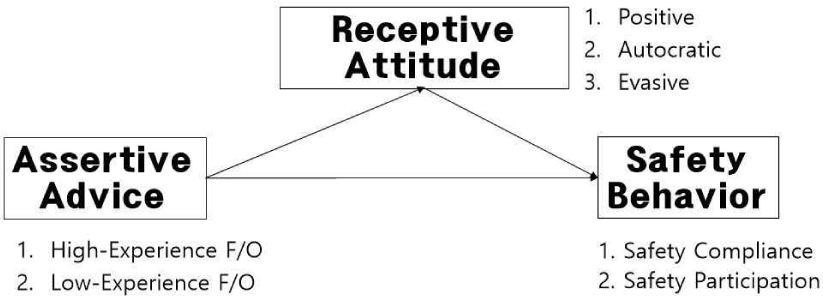
This study sets first officers’ Assertive Advice, differentiated by variations in flight experience, as the independent variable and examines its effects on both the mediating and dependent variables.
The mediating variable, captains’ receptive attitude, was classified into Positive, Autocratic, and Evasive receptive attitudes, dkswjsand the effects of each type were comparatively analyzed. Through this approach, the study aims to verify how the independent and mediating variables influence the dependent variable representing captains’ safety behavior.
Hypothesis 1. First officers’ Assertive Advice will have a positive (+) effect on captains’ safety behavior.
Hypothesis 2. First officers’ Assertive Advice will have a positive (+) effect on captains’ Positive receptive attitude.
Hypothesis 3. First officers’ Assertive Advice will have a negative (−) effect on captains’ Autocratic receptive attitude.
Hypothesis 4. First officers’ Assertive Advice will have a negative (−) effect on captains’ Evasive receptive attitude.
Hypothesis 5. Captains’ Positive receptive attitude will have a positive (+) effect on safety behavior.
Hypothesis 6. Captains’ Autocratic receptive attitude will have a negative (−) effect on safety behavior.
Hypothesis 7. Captains’ Evasive receptive attitude will have a negative (−) effect on safety behavior.
Hypothesis 8. First officers’ Assertive Advice will positively (+) affect captains’ safety behavior through the mediating effect of captains’ Positive receptive attitude.
Hypothesis 9. First officers’ Assertive Advice will positively (+) affect captains’ safety behavior through the mediating effect of captains’ Autocratic receptive attitude.
Hypothesis 10. First officers’ Assertive Advice will positively (+) affect captains’ safety behavior through the mediating effect of captains’ Evasive receptive attitude.
To enable empirical analysis, this study established operational definitions based on existing theories and prior research. Through this process, the conceptual characteristics of each variable were clearly defined, and the subfactors for measuring each variable were systematically constructed.
First, with reference to the Asiana Airlines Flight Operations Manual (FOM), Assertive Advice was defined as “an act in which a first officer clearly and explicitly presents his or her opinion in order to ensure flight safety.”
Next, receptive attitude was reconstructed into three categories—positive, autocratic, and evasive receptive attitudes—by reinterpreting the leadership styles proposed by Lewin et al. (1939) (autocratic, democratic, and laissez-faire) in accordance with the aviation operational environment. Through this approach, the study aims to examine the differential effects of receptive attitudes within the context of cockpit decision-making and interpersonal interaction.
Positive receptive attitude is defined as “an attitude characterized by openly and actively accepting others’ advice or opinions, attentively listening to others’ statements, and attempting to reflect them in the decision-making process.” In contrast, autocratic receptive attitude refers to “an attitude that seeks to control or restrict opinions based on authority and status without sufficiently considering or valuing the advice provided, while emphasizing a top-down decision-making approach that prioritizes commands and directives.” Finally, evasive receptive attitude is defined as “a passive response tendency characterized by avoiding direct reactions to or discussions about presented advice, intentionally delaying or ambiguously maintaining decision-making, or effectively ignoring the advice.”
Lastly, Safety Behavior was established as the dependent variable based on the definition proposed by Kim (2023), referring to safety-related behaviors exhibited by flight crew members under the influence of the independent and mediating variables. In this study, based on first officers’ Assertive Advice and captains’ receptive attitudes, Safety Behavior is defined as “behavior involving compliance with regulations and procedures to ensure flight safety, as well as active participation in activities aimed at improving safety.”
As of August 4, 2025, this study conducted a survey targeting first officers employed by airlines operating in Korea holding an Air Operator Certificate (AOC) issued by the Ministry of Land, Infrastructure and Transport, including full-service carriers, low-cost carriers, hybrid carriers, and cargo airlines. A total of 105 valid responses were collected.
The study sample was limited to first officers employed by airlines operating in Korea. Due to the nature of captains’ roles and authority, there is a possibility of self-defensive responses regarding Assertive Advice. Therefore, captains were excluded in order to ensure the validity of the analysis and the homogeneity of the sample. In addition, foreign first officers were also excluded from the study, as differences in organizational culture may result in different patterns of communication and interpersonal relationship formation.
Data collection was conducted over a 48-day period from August 4 to September 17, 2025, through an online survey using Google Forms. Ultimately, responses from 105 first officers employed by airlines operating in Korea were confirmed as valid samples for analysis.
Assertive Advice was measured using the instrument originally developed by Rathus (1973) and adapted from the questionnaire items translated by Lee (2015). Receptive Attitude was measured by modifying the questionnaire items proposed by Fulham (2022) based on the theoretical framework of Kurt Lewin et al. (1939). Safety Behavior was measured by reflecting the conceptual framework of Neal & Griffin (2004) and the questionnaire items developed by Kim (2023).
To verify reliability and validity, KMO factor analysis and Cronbach’s α coefficients were calculated. The results confirmed that all variables satisfied the criteria for convergent validity and reliability. Statistical analyses were conducted using SPSS, including correlation analysis, t-tests, regression analysis, and bootstrapping-based mediation effect analysis using the PROCESS Macro.
IV. Empirical Analysis
This study conducted a survey of 105 airline first officers over a 48-day period from August 4 to September 17, 2025, and performed frequency analysis using SPSS. The respondents consisted of pilots employed by full-service carriers (FSC), low-cost carriers (LCC), hybrid service carriers (HSC), and cargo airlines. The analysis included gender, age, airline affiliation, career experience, and flight hours.
Among the 105 respondents, 102 (97.1%) were male, accounting for the overwhelming majority, while only 3 respondents (2.9%) were female. This result reflects the gender imbalance structure within the flight crew profession.
Regarding age distribution, respondents in their 30s accounted for the largest proportion with 66 individuals (62.9%), followed by those in their 20s with 21 individuals (20.0%), those in their 40s with 14 individuals (13.3%), and those in their 50s with 4 individuals (3.8%). This distribution may be interpreted as a consequence of limiting the study population to first officers, resulting in a concentration within relatively younger age groups.
In terms of airline affiliation, pilots employed by low-cost carriers (LCC) accounted for the largest proportion with 47 respondents (44.8%), followed by full-service carriers (FSC) with 40 respondents (38.1%), hybrid service carriers (HSC) with 15 respondents (14.3%), and cargo airlines with 3 respondents (2.9%).
Regarding career experience, respondents with 5 to 7 years of experience represented the largest group with 36 individuals (34.3%), followed by those with more than 7 years of experience with 24 individuals (22.9%), and those with 3 to 5 years of experience with 20 individuals (19.0%). In contrast, respondents with less than 1 year of experience accounted for 13 individuals (12.4%), while those with 1 to 3 years of experience accounted for 12 individuals (11.4%), indicating relatively lower proportions.
With respect to flight hours, respondents with more than 2,000 flight hours accounted for the highest proportion with 51 individuals (48.6%). Overall, the findings indicate that the majority of respondents were first officers possessing moderate to high levels of career experience and substantial flight hours (Table 2).
Factor analysis was conducted to extract the underlying factors of the questionnaire items, and an orthogonal rotation method using Varimax Rotation was applied. In addition, Cronbach’s α coefficient was utilized to verify the reliability of the measurement scales (Table 3).
The analysis results showed that the Kaiser-Meyer-Olkin (KMO) values for each variable ranged from 0.77 to 0.81, indicating an acceptable level of sampling adequacy. In addition, Bartlett’s test of sphericity yielded statistically significant results for all variables (p<.001), confirming that the correlations among variables were significant and that the application of factor analysis was appropriate.
Factor loadings were found to exceed 0.70 for all questionnaire items, indicating that each item stably explained its corresponding factor and confirming the validity of the single-factor structure. The cumulative variance explained ranged from 65.33% to 73.15%, suggesting that each factor sufficiently accounted for the overall variance. In addition, all eigenvalues exceeded 1.0, satisfying the criterion for factor retention.
The reliability analysis showed that Cronbach’s α coefficients ranged from 0.832 to 0.871, demonstrating a high level of internal consistency across all constructs. In particular, the variables of positive receptive attitude and safety behavior exhibited relatively high reliability, while all other variables also exceeded the acceptable threshold.
Overall, the measurement items used in this study were determined to possess both validity and reliability, confirming that they constitute appropriate measurement instruments for subsequent analyses.
The results of the correlation analysis revealed statistically significant relationships among the major variables overall. First, Assertive Advice showed significant positive correlations with positive receptive attitude (r=0.48, p<0.001) and safety behavior (r=0.39, p<0.001). In contrast, it exhibited negative correlations with autocratic receptive attitude (r=–0.34, p<0.001) and evasive receptive attitude (r=–0.28, p<0.001).
Positive receptive attitude also demonstrated a significant positive correlation with safety behavior (r=0.52, p<0.001), confirming that a positive receptive attitude is closely associated with the enhancement of safety behavior (Table 4).
| AA | PR | AR | ER | SB | |
|---|---|---|---|---|---|
| AA | - | ||||
| PR | ***0.48 | - | |||
| AR | ***−0.34 | ***−0.41 | - | ||
| ER | ***−0.28 | ***−0.32 | ***0.36 | - | |
| SB | ***0.39 | 0.52 | ***−.42 | ***−0.36 | - |
In contrast, both autocratic receptive attitude (r=–0.36, p<0.001) and evasive receptive attitude (r=–0.42, p<0.001) showed significant negative correlations with safety behavior, suggesting that uncooperative communication styles may hinder safety behavior. In addition, a positive correlation was found between autocratic receptive attitude and evasive receptive attitude (r=0.36, p<0.001), indicating an interrelationship between the two negative attitude types.
Overall, Assertive Advice and positive receptive attitude functioned as positive factors promoting safety behavior, whereas autocratic and evasive receptive attitudes emerged as negative factors that impede such behavior. These findings empirically support the notion that communication styles within the cockpit exert a significant influence on safety behavior.
In this study, simple regression analysis was conducted to verify the effects of first officers’ Assertive Advice on captains’ receptive attitudes and safety behavior. The results indicated that all regression models were statistically significant (p<0.001). In addition, the Durbin–Watson values ranged from 1.88 to 2.04, confirming that the assumption of independence of residuals was satisfied (Table 5).
First, Assertive Advice had a significant positive effect on safety behavior (β=0.39, R2=0.151), explaining approximately 15.1% of the variance. In addition, it exerted a significant positive effect on positive receptive attitude (β=0.48, R2=0.23), demonstrating relatively high explanatory power.
In contrast, Assertive Advice showed significant negative effects on autocratic receptive attitude (β=–0.70, R2=0.116) and evasive receptive attitude (β=–0.28, R2=0.08), indicating that higher levels of Assertive Advice were associated with lower levels of negative receptive attitudes.
Meanwhile, the analysis of the effects of captains’ receptive attitudes on safety behavior revealed that positive receptive attitude was the variable exerting the strongest positive influence on safety behavior (β=0.52, R2=0.274), and it also demonstrated the highest explanatory power. In contrast, both autocratic receptive attitude (β=–0.42, R2=0.176) and evasive receptive attitude (β=–0.36, R2=0.128) were found to have significant negative effects on safety behavior.
Overall, first officers’ Assertive Advice was identified as a key variable that not only directly enhances safety behavior, but also indirectly influences safety behavior by increasing positive receptive attitudes while decreasing autocratic and evasive receptive attitudes. In particular, positive receptive attitude emerged as the variable with the strongest influence on safety behavior, providing empirical support for the importance of positive communication and receptive attitudes within the cockpit environment.
In this study, a bootstrapping-based mediation analysis using Hayes’ PROCESS Macro v4.2 was conducted to verify the effects of first officers’ Assertive Advice on safety behavior through captains’ receptive attitudes. The results indicated that Assertive Advice had a significant positive effect on positive receptive attitude (B=0.46, p<0.001), and positive receptive attitude also exerted a significant positive effect on safety behavior (B=0.53, p<0.001). Accordingly, the indirect effect (B=0.24) did not include zero within the 95% bootstrapping confidence interval, confirming a significant mediating effect.
In contrast, Assertive Advice had significant negative effects on autocratic receptive attitude (B=–0.33, p<0.001) and evasive receptive attitude (B=–0.29, p<0.001), while both variables were found to negatively affect safety behavior (B=–0.41 and B=–0.37, respectively, p<0.001). Furthermore, the indirect effects through autocratic receptive attitude (B=0.14) and evasive receptive attitude (B=0.11) also did not include zero within the bootstrapping confidence intervals, indicating that both mediating effects were statistically significant (Table 6).
Meanwhile, both the direct effect of Assertive Advice on safety behavior (B=0.22, p<0.001) and the total effect (B=0.70, p<0.001) were found to be statistically significant, confirming a partial mediation structure.
Overall, Assertive Advice emerged as a key variable that not only directly influences safety behavior, but also significantly enhances safety behavior through indirect pathways by strengthening positive receptive attitudes while reducing autocratic and evasive receptive attitudes. In particular, the identification of a dual-path structure—where the enhancement of positive receptive attitudes and the reduction of negative receptive attitudes operate simultaneously—provides important empirical evidence explaining the mechanism through which cockpit communication styles influence safety behavior.
This study empirically analyzed the effects of communication among flight crew members of airlines operating in Korea, particularly first officers’ Assertive Advice, on captains’ receptive attitudes and safety behavior. The results revealed that Assertive Advice strengthened captains’ positive receptive attitudes while reducing autocratic and evasive receptive attitudes, and that these receptive attitudes significantly influenced safety behavior. In addition, Assertive Advice was found to exert not only a direct effect on safety behavior, but also an indirect effect mediated through receptive attitudes.
Ultimately, all ten proposed hypotheses were supported, and the findings of this study empirically confirmed that communication and receptive attitudes within the cockpit play a significant role in influencing safety behavior.
Hypothesis 1. “First officers’ Assertive Advice will have a positive (+) effect on captains’ safety behavior” was supported, as positive results were identified in both the correlation analysis and regression analysis.
Hypothesis 2. “First officers’ Assertive Advice will have a positive (+) effect on captains’ positive receptive attitude” was supported, as positive results were identified in both the correlation analysis and regression analysis.
Hypothesis 3. “First officers’ Assertive Advice will have a negative (–) effect on captains’ autocratic receptive attitude” was supported, as negative results were identified in both the correlation analysis and regression analysis.
Hypothesis 4. “First officers’ Assertive Advice will have a negative (–) effect on captains’ evasive receptive attitude” was supported, as negative results were identified in both the correlation analysis and regression analysis.
Hypothesis 5. “Captains’ positive receptive attitude will have a positive (+) effect on safety behavior” was supported, as positive results were identified in both the correlation analysis and regression analysis.
Hypothesis 6. “Captains’ autocratic receptive attitude will have a negative (–) effect on safety behavior” was supported, as negative results were identified in both the correlation analysis and regression analysis.
Hypothesis 7. “Captains’ evasive receptive attitude will have a negative (–) effect on safety behavior” was supported, as negative results were identified in both the correlation analysis and regression analysis.
Hypothesis 8. “First officers’ Assertive Advice will have a positive (+) effect on captains’ safety behavior through the mediating effect of captains’ positive receptive attitude” was supported, as positive results were identified in both the correlation analysis and mediation analysis.
Hypothesis 9. “First officers’ Assertive Advice will have a positive (+) effect on captains’ safety behavior through the mediating effect of captains’ autocratic receptive attitude” was supported, as positive results were identified in both the correlation analysis and mediation analysis.
Hypothesis 10. “First officers’ Assertive Advice will have a positive (+) effect on captains’ safety behavior through the mediating effect of captains’ evasive receptive attitude” was supported, as positive results were identified in both the correlation analysis and mediation analysis.
V. Conclusion
This study conducted a survey of 105 first officers holding Korean nationality and employed by airlines operating in Korea in order to analyze the effects of first officers’ Assertive Advice and captains’ receptive attitudes on safety behavior.
The results indicated that most first officers actively engaged in Assertive Advice, with highly experienced first officers demonstrating more proactive tendencies than those with less experience. Such advice was found to have positive and significant effects on flight safety.
However, the effectiveness of the advice was shown to be largely dependent on captains’ receptive attitudes. When captains exhibited autocratic or evasive attitudes, first officers tended to hesitate in providing advice or behaved more passively and indifferently.
These findings suggest that, for safe flight operations, both proactive communication from first officers and open, receptive attitudes from captains are equally important.
This study empirically confirmed that first officers’ Assertive Advice and captains’ receptive attitudes exert significant influences on captains’ safety behavior.
First, regardless of the quality of the advice itself, the act of providing advice alone produced positive effects in enhancing safety behavior, suggesting that such communication contributes meaningfully to the reinforcement of situational awareness and decision-making.
In addition, captains’ receptive attitudes were identified as a key factor determining safe flight operations. Positive receptive attitudes strengthened safety behavior, whereas autocratic and evasive attitudes were found to hinder safety behavior.
Therefore, airlines should foster an organizational culture that encourages proactive communication from first officers and establish educational, training, and institutional support systems to systematically cultivate captains’ positive receptive attitudes. Furthermore, managerial interventions should be implemented to address negative receptive attitudes, while positive reinforcement strategies, such as providing incentives for exemplary cases, should also be adopted concurrently.
This study was conducted with Korean first officers employed by airlines operating in Korea, and therefore limitations exist in generalizing the findings due to cultural specificity. In addition, although improvement measures through education and training were proposed, the pedagogical and psychological effects of such interventions on changes in captains’ receptive attitudes were not sufficiently verified. Furthermore, because the study adopted a quantitative research design based on survey data, there may be limitations in fully reflecting the actual communication context and specific situational factors within the cockpit environment. The subfactors of the variables were also defined in a limited manner, which may not comprehensively capture the diverse influencing factors present in real operational settings.
Accordingly, future studies should incorporate comparative analyses involving various nationalities and cultural backgrounds, verification of the effectiveness of systematic CBT-based training programs, the integration of qualitative research methods, and expanded analyses including additional variables such as fatigue and workload. Such complementary research is expected to contribute substantially to reducing human factor-related risks and ultimately enhancing safe flight operations by promoting effective cockpit communication and safety behavior.


